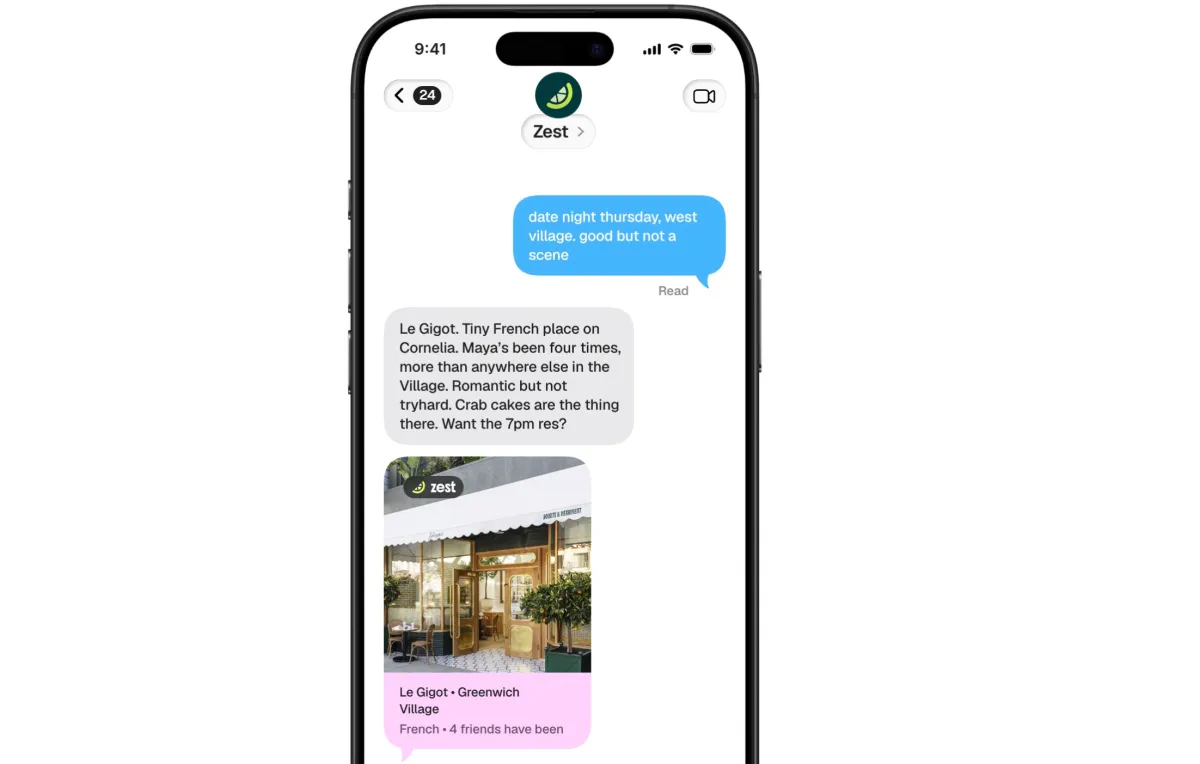
A new AI agent called Zest just made restaurant booking as easy as texting a friend. You describe what you want, Zest finds the spots, and it books the table. No app to download. No account to create. Just a text message. The people building voice-first and text-first consumer products have been waiting for this moment, and it is finally here in 2026.
Why This Is Happening Now
Restaurants have a booking problem. Walk-in culture collapsed after 2020. Reservation platforms like OpenTable and Resy charge restaurants per cover, and those fees add up fast. According to Statista, the global online food services market is projected at over $1.2 trillion in 2026. There is a lot of money at stake in who controls the booking layer.
At the same time, text messaging has become the dominant consumer channel. According to SimpleTexting, SMS messages carry a 98% open rate compared to roughly 20% for email. That gap is enormous. Any product that lives inside the text thread where people already spend their time has a structural advantage over anything that requires opening a separate app.
Zest is betting that the combination of large language models and real-time restaurant data creates a product most people will actually use. You text something like “find me a good Italian spot near downtown with a table for two on Friday at 7” and Zest handles the rest. It is the kind of thing that sounds obvious once you see it. That is usually the sign of a good product.
The Bigger Play Nobody Is Talking About
Most people will read about Zest and think “oh, a smarter OpenTable.” That is the wrong frame. Think about what a conversational AI agent sitting between a consumer and a local business actually captures over time. Every search. Every preference. Every dining decision. The reservation is almost beside the point.
This is a data play dressed up as a convenience product. And I mean that as a compliment.
The companies that win in AI right now are not the ones with the best models. The models are largely commoditized at this point. The winners are the ones who own the consumer relationship at the point of decision. Google knows this. Apple knows this. That is why Apple Intelligence is baking reservation-style actions directly into Siri. According to The Verge’s 2025 coverage of Apple’s developer conference, Apple specifically called out local search and booking as a core use case for their on-device AI features.
Zest is trying to own that relationship before the big platforms fully wake up. That is a real window, and it is probably smaller than the founders think.
Here is the honest contrarian take: the restaurant reservation space has extremely low switching costs for consumers. If Zest books your table, great. But if Google or Apple integrates the same feature into a product you already use every day, why would you text Zest? The moat question matters here, and I have not seen a convincing answer yet.
That said, being first in a consumer habit loop is worth something. According to research from Bain and Company, increasing customer retention by just 5% can increase profits by 25% to 95%. If Zest can get into the daily text habit of even a small segment of urban consumers, that is a valuable asset regardless of how the platform wars shake out.
Founders building in adjacent spaces should be paying close attention. If you are creating content about local food, city guides, or lifestyle brands, a tool like InVideo AI lets you turn your written takes into short-form video without a production team, which pairs well with building an audience in this space.
What I Would Do With This Information
If you are a restaurant owner or operator, pay attention to this trend whether or not Zest specifically takes off. The booking layer is moving toward conversational AI. Your job is to make sure your restaurant shows up correctly in the places these agents pull data from. That means keeping your Google Business profile current, your hours accurate, and your menu data clean. These agents are only as good as the data they index. If your data is stale, you do not get booked.
If you are a consumer, try it. Text-based booking with no app friction is genuinely useful. The value proposition is real even if the company behind it is still finding its footing.
If you are an investor or builder, the pattern here matters more than the company. Any service where a consumer makes a recurring micro-decision, restaurants, haircuts, car washes, fitness classes, is a candidate for a conversational AI layer. The addressable market for AI agents that handle local service booking is enormous. According to IBISWorld, the restaurant industry in the US alone generates over $900 billion per year. Even a small slice of the booking layer is worth a lot.
For builders working on content around this space, AppSumo regularly surfaces early-stage tools in the AI productivity category, including products that can help you automate research, publishing, and audience building without enterprise-level budgets.
One practical move right now: if you own a local business of any kind, audit your data presence on every major platform. Google, Yelp, Apple Maps, and any vertical directories in your niche. AI agents trained on stale data will steer customers away from you without anyone realizing it. Fix the data, then worry about the apps.
The Bottom Line
Zest is not just a clever restaurant app. It is an early proof of concept that conversational AI can own the last mile of local commerce. Whether Zest specifically wins is almost irrelevant. The behavior it is building is real. Consumers want to get things done in the same thread where they talk to people. The businesses and builders that position themselves inside that behavior now will have an advantage that compounds. Everyone else will be paying to catch up.
Frequently Asked Questions
What is Zest and how does its AI agent work?
Zest is a text-based service where you describe what kind of restaurant experience you want and the AI finds options and books a reservation for you. It is designed to work through SMS so you do not need a dedicated app. The agent handles the search and booking conversation on your behalf.
Is this different from just searching Google for restaurants?
The key difference is that Zest handles the booking step, not just the discovery step. Google will show you options but you still have to click through and complete the reservation yourself. A conversational agent that completes the full transaction in one thread is a meaningfully different experience, especially on mobile.
Will AI agents replace restaurant reservation platforms like OpenTable?
Not quickly, and probably not completely. OpenTable and Resy have deep relationships with restaurants and handle the actual reservation management software. An AI agent layer is more likely to sit on top of existing infrastructure than replace it. The question is who controls the consumer relationship at the point of search.
What should restaurant owners do to prepare for AI-driven booking?
Audit your data on every platform that AI agents might use as a source. That includes Google Business, Yelp, Apple Maps, and any vertical directories. Outdated hours, closed listings, or missing information will cause AI agents to skip your restaurant entirely. Clean data is your first line of defense.
Is the AI restaurant booking market worth paying attention to as an investor?
The overall local commerce addressable market is massive. According to IBISWorld, just the US restaurant industry tops $900 billion annually. The specific product opportunities are still early and unproven, but the direction is clear. Any builder who can own the consumer decision moment in a high-frequency local category is building something worth watching.