Linux Laptop Beats MacBook Pro in 4 Surprising Ways
“`html
Linux Laptop Beats MacBook Pro in 4 Surprising Ways
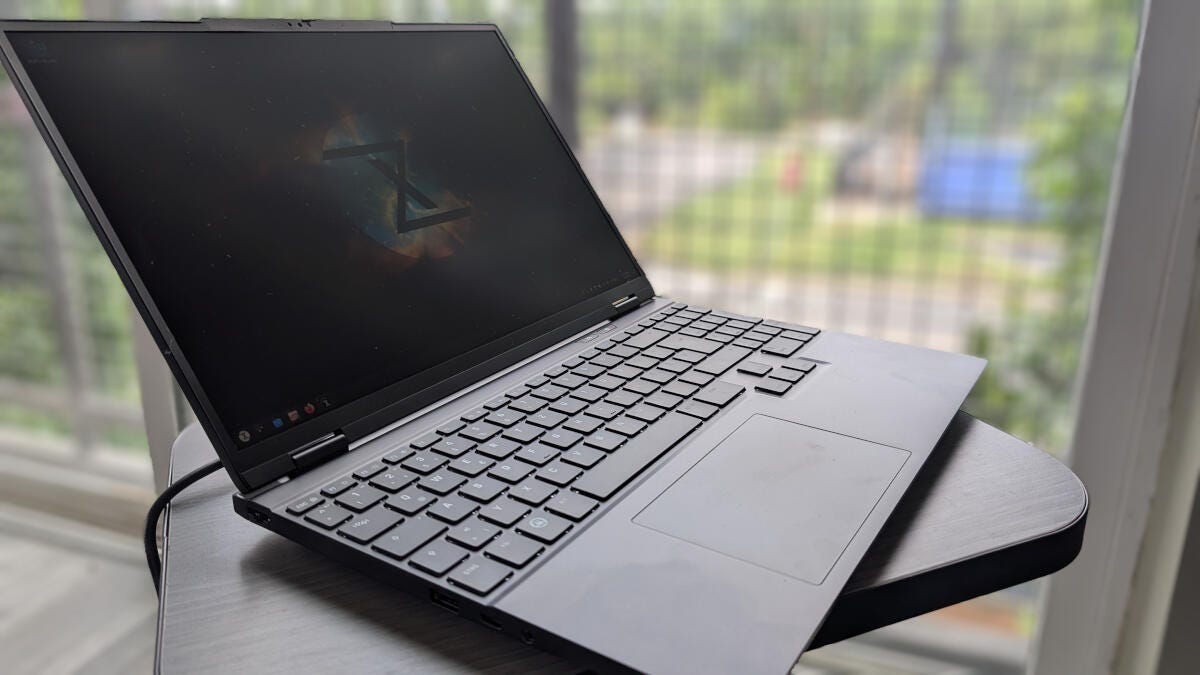
I put the TUXEDO InfinityBook Max 15 Gen10 next to my MacBook Pro, and the results shocked me. At roughly €1,800, this Linux machine outperforms Apple’s €2,249 MacBook Pro 14″ in several areas that actually matter for serious work in 2026.
Why This Comparison Matters Right Now
Apple has dominated the premium laptop conversation for years. Most tech writers treat a MacBook Pro as the obvious choice. I think that’s lazy thinking, and the numbers are starting to prove it.
TUXEDO launched the InfinityBook Max 15 Gen10 in 2026 as what they call their most powerful Linux laptop yet. It ships with an Intel Core Ultra 7 255H processor, up to 128GB of DDR5-5600 RAM, up to 8TB of NVMe PCIe 4.0 storage, and your choice of an NVIDIA RTX 5060 or RTX 5070 with 8GB of GDDR7 memory, according to TUXEDO Computers. The display hits 2560×1600 at 300Hz with 500 nits of brightness. Wi-Fi 7 and Thunderbolt are standard.
This machine is built for people running AI workloads, financial modeling, and data analysis on open-source tools. The timing isn’t an accident. Demand for x86 Linux machines with discrete GPUs has spiked alongside the broader AI boom, and TUXEDO is clearly targeting that wave.
Where the TUXEDO Actually Wins
Let me be direct. The MacBook Pro is a better computer in some ways. Single-core performance still favors Apple. According to Geekbench 6 benchmarks, the MacBook Pro 16″ from late 2023 scored 3,137 in single-core tests versus 2,685 for the TUXEDO InfinityBook Pro Gen8, a 17% gap in Apple’s favor.
But here’s where the story flips. Multi-core Object Detection benchmark scores show the TUXEDO pulling ahead at 2,588 versus 2,555 for the MacBook Pro, according to Geekbench 6 data. That’s a small margin, but it matters when you’re running parallel AI inference jobs or processing large financial datasets. The MacBook wins big in Text Processing at 3,752 versus 2,547 for the TUXEDO, a 32% gap, according to the same Geekbench 6 results. So pick your battles carefully.
Where the TUXEDO genuinely embarrasses Apple is RAM. The InfinityBook Max 15 supports up to 128GB of DDR5 RAM. The MacBook Pro tops out at 36GB of unified memory in comparable tests, according to Geekbench 6 data. If you’re doing serious machine learning training with TensorFlow, running multiple Docker containers, or keeping massive financial models open alongside market data feeds, that memory ceiling matters enormously.
Repairability is another area where Apple loses badly. The InfinityBook uses user-replaceable RAM and storage. Apple solders everything down. If something breaks on your MacBook Pro out of warranty, you’re paying Apple’s prices or losing the machine. With the TUXEDO, you’re not locked into that cycle.
The NVIDIA RTX 5060 and 5070 options also open doors Apple simply can’t. Apple’s GPU architecture doesn’t support CUDA, which is still the dominant compute platform for AI and scientific workloads. If your tools depend on CUDA, a MacBook isn’t even a real option. The TUXEDO is.
On the security side, Linux-first hardware with full driver compatibility actually reduces your attack surface in meaningful ways. But running any connected machine without endpoint protection is still a bad idea. I use TotalAV antivirus protection on my Linux machines because the threat for Linux endpoints has grown sharply as more professionals move to it.
What This Means For You
If you’re a professional who picked a MacBook Pro because everyone else did, I’d ask you to stop and think about what you’re actually paying for.
You’re paying €2,249 or more for a machine that outperforms in single-core tasks and Text Processing benchmarks. You’re also paying for a walled where Apple controls your repairs, your upgrade path, and your software choices. That’s a real cost that doesn’t show up in the spec sheet.
Here’s what I would do. If your work involves AI model training, financial data analysis in Python or R, or any CUDA-dependent workload, the TUXEDO InfinityBook Max 15 Gen10 is the smarter buy at this price point. The €400 or more you save over a comparable MacBook Pro is money you can put toward more RAM or faster storage.
If you’re a creative professional who lives inside Final Cut Pro or Logic Pro, the MacBook Pro still makes sense. Those apps are optimized for Apple silicon in ways that third-party Linux tools can’t fully match yet.
For finance professionals and AI developers, though, the TUXEDO running open-source tools on native Linux is a serious option. You get full control over your environment, better RAM headroom, and GPU compute that Apple can’t offer.
One practical note: switching to Linux full-time means tightening your security habits. I’d recommend pairing the TUXEDO with Norton security suite for network-level threat monitoring, especially if you’re handling sensitive client data or proprietary financial models. Good hardware deserves good protection.
Battery life on the Pro 14 model came in at about 7.5 hours for office work with Wi-Fi and Bluetooth on at 50% brightness, according to TUXEDO Computers review data. That’s solid for a Windows-class machine but still behind what Apple’s M-series chips deliver. Plan accordingly if you work away from power outlets often.
The Bottom Line
The MacBook Pro is not automatically the right answer anymore. The TUXEDO InfinityBook Max 15 Gen10 costs less, offers more RAM, supports CUDA, and lets you actually repair what you own. For AI developers and finance pros running Linux workloads, this machine is the better investment. Apple sells you a brand. TUXEDO sells you a tool. In 2026, professionals who know the difference are switching.
Frequently Asked Questions
Is the TUXEDO InfinityBook Max 15 good for cybersecurity professionals?
Yes, it’s a strong fit for cybersecurity work. It runs Linux natively with full hardware compatibility, which matters for tools like Wireshark, Metasploit, and other security utilities that work best on Linux. The 128GB RAM ceiling and NVIDIA GPU also support resource-heavy tasks like malware sandboxing and network simulation.
How does the Linux laptop compare to MacBook Pro for everyday use?
For general browsing and document work, both machines perform well. The MacBook Pro edges ahead in single-core speed, which affects snappy everyday responsiveness. But the TUXEDO Linux laptop closes that gap fast in multi-core workloads and offers far more memory for power users.
What is the price difference between the TUXEDO InfinityBook and MacBook Pro?
A comparable TUXEDO InfinityBook Pro configuration runs around €1,800 versus roughly €2,249 for a MacBook Pro 14″ with a similar GPU in France, according to TUXEDO Computers and Apple pricing data. That’s a roughly €450 difference that buys you meaningfully better specs on the TUXEDO side.
Can I run AI and machine learning workloads on the TUXEDO InfinityBook Max 15?
Absolutely. The RTX 5060 and RTX 5070 GPU options support CUDA, which is required for most major AI frameworks including TensorFlow and PyTorch. The up to 128GB RAM configuration also removes the memory bottleneck that limits Apple silicon machines during large model training runs.
Is Linux secure enough for professional use in 2026?
Linux is generally more secure by default than Windows, but no operating system is immune to threats. For professionals handling sensitive data, pairing a Linux machine with dedicated endpoint protection adds a critical layer of defense that the base OS alone doesn’t provide.
“`
Get stories like this in your inbox. Daily.
Free. No spam. The AI, tech, and finance stories that move money.