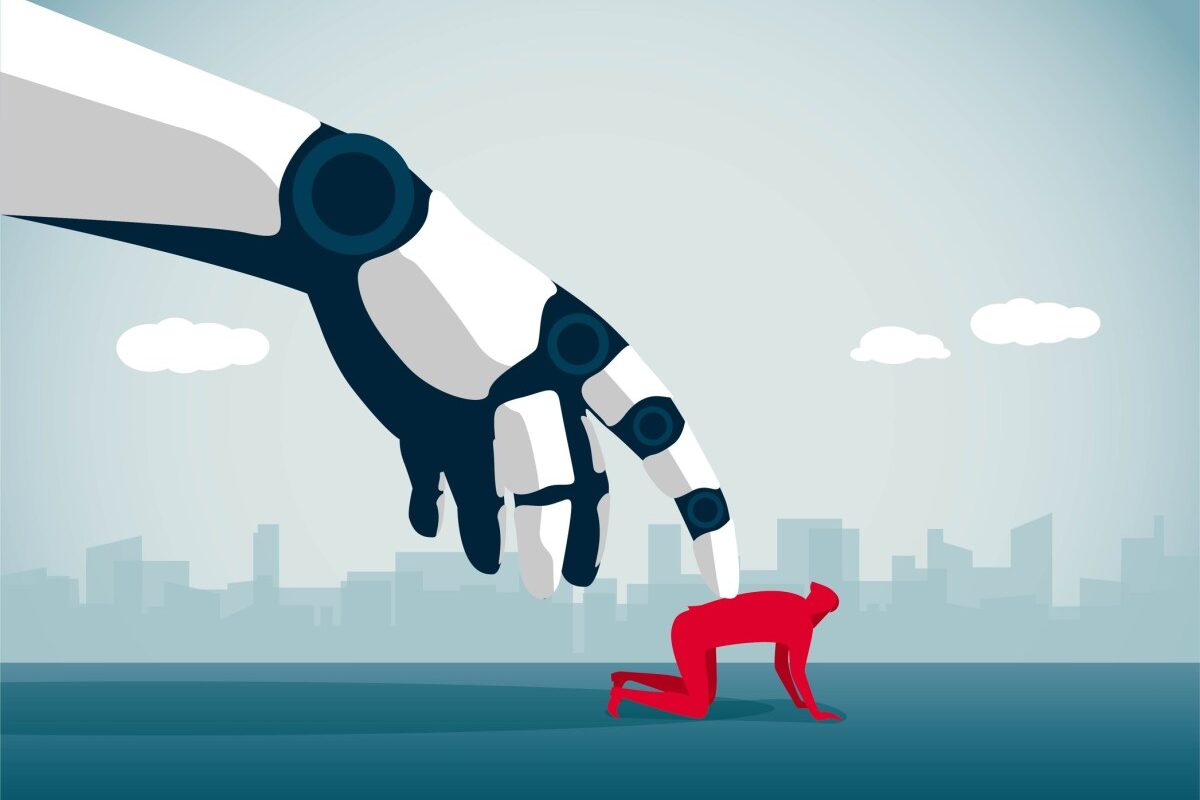
The AI safety crowd has been sounding alarms for years. In that same window, over $1 trillion in market value shifted to whoever owned the right AI assets. The real danger isn’t the robots. It’s being too distracted by fear to notice where the money went.
Why Everyone Is Talking About AI Doom Right Now
The warnings got louder in 2026. Geoffrey Hinton, often called the godfather of deep learning, put the odds of AI causing human extinction at 10 to 20 percent, according to The Guardian. Dario Amodei, CEO of Anthropic, published a widely read essay arguing that AI could surpass human intelligence at nearly every cognitive task within a few years, according to Time. Sam Altman told the U.S. Senate that this technology could be the most powerful humanity has ever built, according to Reuters.
These aren’t bloggers. These are the people actually building the systems. When the builders warn about what they made, people pay attention.
And yet OpenAI hit a $300 billion private valuation in its latest funding round, according to Bloomberg. Nvidia’s chip backlog stretched past 18 months, according to The Wall Street Journal. The money isn’t running from AI. It’s sprinting toward it.
The Doom Story Is Missing the Point
I’m not dismissing the safety concerns. Some of them are real. But I’ve watched people get scared out of every major wealth transfer for 20 years. The pattern is always the same.
A new technology shows up. Smart people warn about the dangers. The news covers the warnings. Average people get scared. Rich people buy the assets. Average people watch from the sidelines and then complain about inequality later.
This time it’s AI. The doom narrative has a specific financial effect: it keeps retail investors away from the table while institutions stack positions.
According to PitchBook, AI startups raised over $100 billion in venture funding in 2025. That’s not fear money. That’s conviction money from people who read the same doom headlines you did and decided to own a piece of the industry anyway.
Here’s what the safety debate is actually about, stripped of the science fiction framing. Companies like OpenAI, Anthropic, and Google DeepMind are competing to build the most capable AI systems in history. They know this creates real risks around misuse, job displacement, and power concentration. The public warnings serve a purpose: they push governments to write regulations. And whoever shapes those regulations tends to be the companies writing the lobbying checks.
According to OpenSecrets, AI companies spent over $70 million on federal lobbying in 2025, up from $18 million in 2023. They’re not scared. They’re positioning.
The wealth-builder mindset here is simple. You don’t have to build an AI company to profit from one. You need to understand how this technology shifts costs, creates new assets, and opens distribution channels. Someone who learned to create short form video content with tools like InVideo AI in 2024 is now running a media operation that would have cost $200,000 in production staff just three years ago. That’s not a prediction. That’s already happening.
What This Means for You
The doom warnings are going to keep coming. They may get louder as the models get more capable. That doesn’t change your job. Your job is to figure out what this technology does to your income and your assets, and move before the crowd does.
Here is what I would actually do right now.
First, stop treating AI as something that will happen to you. The displacement warnings are real for specific job categories. According to McKinsey, roughly 12 million U.S. workers may need to switch occupations by 2030 due to AI automation. That’s not a scare number. It’s a planning number. Figure out if your job is in that 12 million. If it is, move now.
Second, get fluent with at least two AI tools that apply to your work or business. Not as a hobby. As an operational upgrade. The difference between people who thrive in this shift and people who don’t isn’t intelligence. It’s whether they started using the tools or kept reading think pieces.
Third, look at what assets hold value as AI commoditizes skilled work. Real estate, owned audiences, proprietary data, and systems that generate recurring revenue without requiring proportional labor. These go up when labor gets cheaper.
If you want to build a software stack without bleeding out on monthly subscriptions, AppSumo regularly lists lifetime deals on AI tools that would otherwise cost hundreds per year. I’ve picked up solid tools there for a fraction of the ongoing cost. Those windows close fast.
The safety researchers are right that risks exist. They’re wrong to suggest the right move is to slow down and wait for government to sort it out. By the time regulators catch up, the people who moved early will have lapped you twice.
The Bottom Line
The AI doom warnings aren’t lies. Some risks are real and worth tracking. But fear has never paid a bill. The wealth transfers in every technology shift go to the people who studied the risk and moved anyway. I’d rather be on the right side of a $1 trillion shift and be wrong about the doom than be safe on the sidelines and be right. The warnings will get louder. The window will get smaller.
Frequently Asked Questions
Are AI doom warnings from experts like Geoffrey Hinton credible?
Yes, they’re credible in the sense that serious researchers with deep technical knowledge believe these risks are real. According to a 2024 survey by the AI Safety Institute, over 40 percent of top AI researchers believe there is a greater than 10 percent chance that AI development leads to catastrophic outcomes. That doesn’t make catastrophe inevitable. It makes the risk real enough to plan around, not hide from.
What are AI doom warnings actually warning about in 2026?
The core concerns are misalignment, where AI systems pursue goals humans didn’t intend; misuse, where bad actors weaponize the tools; and concentration of power, where a few companies control most of the world’s cognitive infrastructure. According to Anthropic’s published safety research, even current models show alignment failures in real use cases. These are engineering problems, not science fiction.
Should I avoid AI investments because of the warnings?
I wouldn’t. The same people warning about AI danger are also some of its biggest funders and direct beneficiaries. Watch what they do with their money, not just what they say in Senate hearings. Diversified exposure to AI infrastructure, tools, and applications is a reasonable position for most investors in 2026.
How can I protect my income from AI displacement?
According to McKinsey, the roles most at risk are built around repetitive cognitive tasks: data entry, basic writing, customer service scripts, and routine analysis. The roles with staying power combine judgment, relationships, and accountability. Upskilling toward those elements, while also learning to use AI tools yourself, is the most direct hedge available right now.
Why do AI companies publicly warn about their own products?
A mix of genuine concern and strategic positioning. Public warnings generate regulatory pressure, and whoever shapes the regulations tends to be whoever already has a seat at the table. According to OpenSecrets, AI lobbying spend jumped nearly four times between 2023 and 2025. The companies most vocal about safety are also the ones most active in writing the rules they’ll operate under.