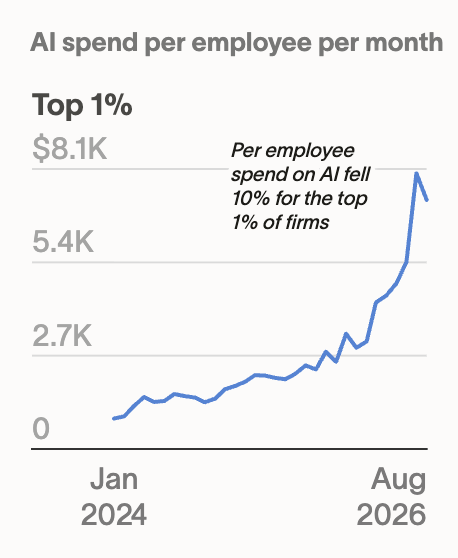
AI software spending per employee at S&P 500 companies fell 18% in August 2026 compared to July, according to Bernstein Research. One month. Eighteen percent. That is the sharpest single-month drop since enterprise AI budgets became a boardroom priority in 2024. Most analysts called it a summer slowdown. I call it a reckoning that was overdue by about two years.
Why This August Drop Matters More Than You Think
August is always slow. CFOs take vacation. Procurement stalls. Renewal cycles push to September. So some pullback was expected. But 18% is not a vacation-week rounding error. And the drop was not uniform across the board.
According to Morgan Stanley’s enterprise tech survey published in late August 2026, the sharpest cuts came in AI productivity tools and copilot subscriptions, not infrastructure. Companies kept their compute spend. They pulled back on the software seats they bought for workers.
That distinction matters a lot. Infrastructure spend holding steady while per-seat AI tool spend craters means one of two things. Either companies are consolidating onto fewer, better tools. Or they bought seats their employees never opened, found out, and stopped renewing. Based on what I am seeing in enterprise adoption data, it is mostly the second one.
According to IDC’s Q2 2026 Enterprise AI Adoption Tracker, only 31% of enterprise AI seats purchased in the first half of 2026 showed active weekly usage by employees. Nearly seven in ten seats were ghost seats. Bought, provisioned, and ignored. That is not a usage problem. That is a change management failure baked into every budget spreadsheet in corporate America.
The Contrarian Take Nobody Wants to Hear
Here is what I actually think is happening. The enterprise AI arms race of 2024 and 2025 was driven by fear, not results. CFOs approved budgets because their competitors were approving budgets. Nobody wanted to be the company that missed AI. So they bought seats. They stood up internal chatbots. They ran pilot programs with three teams and called it a win.
Now it is 2026. The fear spending is running out. CFOs want to know what they got for it. And in a lot of cases, the honest answer is: not enough to justify the renewal at full price.
According to Gartner’s 2026 Hype Cycle for AI, enterprise AI sits firmly in the Trough of Disillusionment right now. Active adoption stalled at around 41% of Fortune 500 companies claiming AI use in core workflows, down from projections of 68% by this point. The gap between projection and reality is where your AI budget went.
Here is what the rich versus poor mindset looks like in this moment. The average corporate employee sees AI spend slowing and thinks the trend is over. The sharp operator sees AI spend slowing and thinks: prices are about to get competitive, vendors are going to negotiate, and the tools that were too expensive six months ago are suddenly on sale.
That is exactly what is happening. When enterprise budgets tighten, SaaS vendors that were previously VC funded and price insensitive start cutting lifetime deals to lock in cash. AppSumo has been busy all summer for exactly this reason. The smart move right now is to find the two or three tools that actually move your output numbers and lock them in before enterprise demand comes back and prices reset higher.
What This Means for You
If you run a team or a business, the August data tells you something useful. The productivity gains from AI are real, but they are not evenly distributed. They go to the people who picked one or two tools, learned them deeply, and built them into their actual workflows. Not the people who bought twelve subscriptions and opened them twice.
Here is what I would do right now. First, audit every AI tool in your stack. If something has not shown up in your workflow in the last 30 days, cancel it. The August pullback at big companies is proof that unused seats are a line item that eventually gets cut. Do not wait for your CFO to do it for you.
Second, go deep on the tools that actually produce measurable output. Video content is one of the clearest ROI cases I have seen this year. Teams using InVideo AI to turn articles and data into short form video are generating three to five times the social reach of text only content, and doing it in a fraction of the time. That is the kind of output that survives a budget audit.
Third, use this window. Enterprise buyers are pausing. That means software companies are hungry for individual and small business customers. The August slump in enterprise spend is your signal that the vendor side of this market is about to get a lot more flexible on pricing.
The companies that come out of this correction ahead will not be the ones who spent the most in 2024 and 2025. They will be the ones who figured out which one or two tools actually make their people faster, locked those in at good prices during the pause, and built the habit before the next buying cycle starts.
The Bottom Line
An 18% single-month drop in AI spend per employee is not summer doldrums. It is a ROI reckoning. Most enterprise AI buyers spent the last two years purchasing fear. Now they are paying for the audit. The companies that treated AI tools like gym memberships, bought them and never showed up, are cutting spend. The operators who actually used the tools are doubling down. This correction separates those two groups. Which one are you in?
Frequently Asked Questions
What caused AI spend per employee to drop in August 2026?
According to Bernstein Research and Morgan Stanley’s enterprise surveys, the primary driver was non-renewal of underused AI productivity tool seats. Companies bought subscriptions in 2024 and 2025 as a reaction to competitive pressure, and August renewal cycles revealed extremely low actual usage. Seasonal slowdowns added to the effect but were not the root cause.
Is AI spend per employee likely to recover in Q4 2026?
Most analyst projections suggest a modest Q4 rebound as procurement cycles restart and companies prioritize tools with measurable output per worker. However, the era of blanket AI seat purchases appears to be over. Spending will consolidate around a smaller number of tools that demonstrate clear, auditable productivity gains.
Which industries saw the biggest drop in AI spend per employee?
According to IDC’s Q2 2026 Enterprise AI Adoption Tracker, financial services and professional services firms saw the steepest per-employee cuts, particularly in AI writing and copilot tools. Sectors with clearer ROI measurement, like logistics and manufacturing, held spending steady or grew it slightly through the same period.
Does lower AI spend per employee signal a broader tech slowdown?
Not necessarily. Infrastructure AI spend, including compute, APIs, and model access costs, held flat or grew through August, according to major cloud provider earnings reports. The pullback was concentrated in front end productivity tools and copilots, not in the underlying infrastructure that serious AI builders depend on.
What is the right AI spend per employee benchmark for a small business?
There is no universal number, but the principle is simple: spend only on tools your team actually uses weekly and can connect to a measurable output improvement. Two or three deeply integrated tools will outperform ten subscriptions nobody opens. The August enterprise data proves that at scale.