Here is the full article: — “`html
AI Menus Are Making Every Restaurant Look the Same
Restaurants assumed AI menus would give them an edge. Instead, they handed the same tools to their competitors. According to Cornell’s Food and Brand Lab, descriptive menu language can boost sales by 27%. But when every restaurant uses the same AI to write those descriptions, nobody wins. You just get sameness. And sameness kills margin.
What’s Happening Right Now
Walk into any midrange restaurant today and open the menu. You’ll see “perfectly seared,” “tender and juicy,” “house-made with care.” Go to the restaurant next door. Same phrases. Same structure. Same photos with the same warm golden lighting and the same shallow depth of field on the same ceramic plate.
This isn’t coincidence. According to the National Restaurant Association, more than 40% of U.S. restaurant operators now use AI tools for some form of content creation, up from under 10% in 2023. Three or four dominant tools command most of that market share. When the majority of restaurants prompt the same models with the same generic inputs, the outputs converge. Every dish sounds like the same dish. Every photo looks like the same photo.
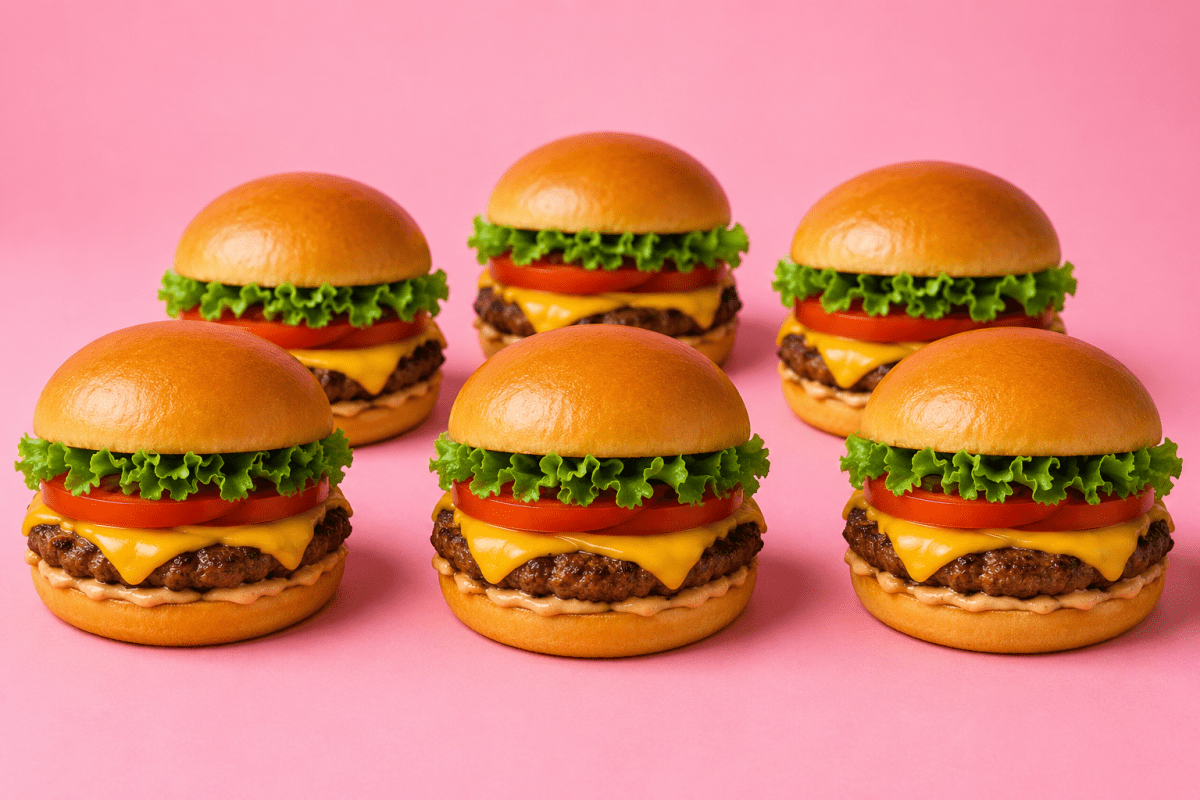
The AI food photo problem is even more visible than the copy problem. Midjourney, DALL-E, and their competitors produce food imagery with a recognizable signature: colors that are too vivid, a glossiness no actual dish ever had, and portion sizes that couldn’t exist on a real plate. Diners don’t always articulate why the photo looks wrong. But they feel it. And that feeling is not a buying signal.
The Sameness Problem Is a Revenue Problem
Here’s what I find maddening about this. Restaurants spent decades building visual identity. The handwritten chalkboard menu. The photography that showed real light from the real kitchen. The menu copy that sounded like the chef wrote it, because she did. That authenticity had real dollar value attached to it.
Cornell’s hospitality research found that diners at restaurants with higher perceived authenticity spend an average of 16% more per check. That’s not a rounding error when you’re running on 5% net margins. Authenticity is a financial asset, and the AI sameness wave is quietly eroding it at restaurants that aren’t paying attention.
According to Technomic’s 2025 dining trends research, “menu fatigue” ranked among the top five reasons repeat visit rates declined in the casual dining segment. Their data flagged a specific pattern: diners who described a restaurant’s menu as feeling “generic or impersonal” were 34% less likely to return within 90 days. AI generated content, done carelessly, is the fastest path to generic and impersonal.
The rich versus poor mindset split here is obvious once you see it. The average restaurant owner sees AI menu tools and thinks: “This saves me time and money on copywriting.” That’s the employee mindset applied to a business problem. The owner mindset says: “If every one of my competitors uses the same tool, using that tool is now the floor, not the ceiling.” Smart operators are already asking what comes after the AI sameness wave, not riding it toward the middle.
If you want your brand to actually stand out while competitors flatten themselves, the next edge is video. Operators using short clips that show the real texture and energy of their space are pulling engagement that static AI photos can’t touch. Tools like InVideo AI make it possible to produce that kind of content fast, without hiring a production crew.
What This Means for You
If I ran a restaurant right now, I’d use AI for the first draft and humans for the edit. Not the other way around. Let the AI write an initial menu description. Then have someone who actually ate the dish rewrite one line of it in plain, specific language. “The pasta tasted like Sunday at my grandmother’s house.” That’s a sentence no AI writes on its own, and it’s exactly the kind of sentence that makes people order.
On the photo side, real photography still wins. A decent smartphone with good natural light beats an AI render every time. Customers can’t always explain why one photo makes them hungry and another doesn’t. But they order differently based on it. The imperfect real photo outperforms the perfect fake one.
Here’s the specific audit I’d run first. Pull your menu. Pull the menus of your three nearest competitors. Read all four without looking at the restaurant names. If the descriptions feel interchangeable, you have a problem that AI didn’t create but AI accelerated.
Then fix it in three moves. Write at least one line per dish with a concrete sensory detail, an origin note, or a story. Replace any AI generated photos with real ones, even phone photos in good light. And if you’re building a broader content and brand presence, AppSumo often surfaces affordable lifetime deals on design and content tools that can help you maintain a consistent, human-feeling identity without agency pricing.
The menus that win in the next two years won’t be the ones with the most polished AI output. They’ll be the ones that feel like a real person made them for real people. That problem is solvable. You just have to choose to solve it instead of automating your way to average.
The Bottom Line
AI menu tools aren’t the enemy. Lazy adoption is the enemy. Every time a restaurant uses the same tool the same way as every competitor, they subtract from their own brand. The operators who learn to use AI without letting AI erase their identity will capture the customers everyone else is quietly losing. That gap is already opening. You’re either building toward it or falling into it.
Frequently Asked Questions
Why do AI-generated menus all look and sound the same?
Most restaurant operators are using the same two or three AI tools with nearly identical default settings and prompts. When many businesses use the same models with similar inputs, the outputs converge toward a generic average. The result is menu copy and food photos that feel interchangeable across restaurants, neighborhoods, and even cities.
Does AI menu content actually hurt restaurant sales?
The evidence points that way. According to Technomic’s 2025 dining trends research, diners who found a menu feeling “generic or impersonal” were 34% less likely to return within 90 days. Repeat visits are where most restaurant revenue comes from, so anything that erodes that metric hits the bottom line directly.
What is the sameness problem in AI menus?
The sameness problem is what happens when many businesses use the same AI tools with the same generic prompts. Outputs converge instead of differentiate. For restaurants, this means descriptions that sound identical, food photos with the same artificial look, and a brand identity that feels borrowed rather than owned.
How can a restaurant stand out when AI makes everything look generic?
Use AI for first drafts, then edit with a human who actually knows the dish. Replace AI generated food photos with real smartphone photography in good natural light. Write at least one specific sensory or origin detail per dish. Those small choices separate your menu from the AI averaged noise around you.
Is AI menu generation worth using at all?
Yes, but only as a starting point. According to the National Restaurant Association, AI content tools are now standard across 40% of operators, so they’re not going away. The winning approach is using AI to accelerate the first draft while applying human editing to reclaim specificity and brand voice. The tool isn’t the problem. Treating the first draft as the final draft is.