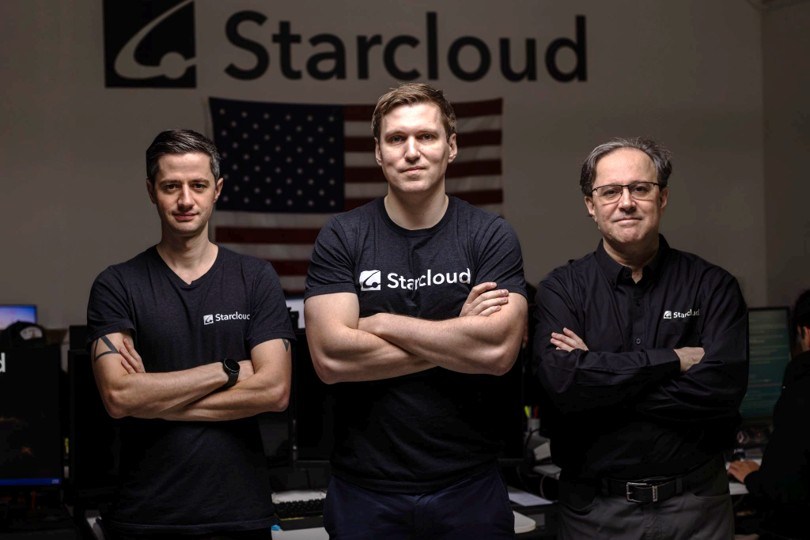
Starcloud just closed a $250 million round to build data centers in orbit. Not metaphorically. Actual servers, in actual space. The reason they need a quarter billion dollars makes sense once you understand what’s happening on the ground: power is running out, launch slots are getting scarce, and whoever locks up orbital compute capacity now owns the infrastructure everyone else will pay to use later.
Why This Is Happening Right Now
The AI boom broke the data center business model. Every major tech company is racing to add compute capacity, and the bottleneck isn’t software or chips anymore. It’s physical space, water, and electricity.
According to Goldman Sachs, data center power demand will grow 160% by 2030. That’s a near doubling of one of the most power-hungry industries on Earth, compressed into four years. Cities are rejecting data center permits because they can’t handle the grid load. Virginia, the largest data center market in the world, has significantly slowed approvals. Ireland blocked new data center grid connections in parts of the country entirely. The ground is genuinely running out of room.
So Starcloud looked up.
At the same time, the number of companies that can actually get you to orbit is shrinking relative to demand. According to BryceTech, SpaceX accounted for more than 60% of all global orbital launch mass in 2025. Rocket Lab handles a fraction of that volume. Everyone else is still proving their rockets work. Launch slots are now being booked further out than ever, and prices are not falling as fast as the market once hoped.
The Contrarian Case for Orbital Compute
Here’s what most coverage gets wrong about Starcloud’s raise. People are treating this like a moonshot bet on futuristic technology. It isn’t. It’s a real estate play.
Think about what orbit actually offers a data center operator. Unlimited solar power with no grid dependency. Zero cooling costs because heat radiates directly into space. No zoning board. No NIMBY neighbors. No water rights fights. No physical security perimeter to staff and guard. The hardware floats in a vacuum at no additional expense.
The cost problem is real but shrinking. Getting hardware to low Earth orbit still runs roughly $2,000 to $5,000 per kilogram even on SpaceX rockets, according to publicly available Falcon 9 pricing. That’s expensive. But when you factor in the full lifetime cost of a ground data center including land acquisition, power contracts, cooling systems, staff, and security, the math looks very different for certain workloads.
The workloads that matter most are ones nobody wants to talk about publicly: defense contracts, intelligence processing, and financial applications where latency to a satellite constellation beats latency to a terrestrial server. Starcloud’s backers understand this clearly. A large portion of that $250 million isn’t going to research and development. It’s going to secure launch capacity and get hardware in orbit before the competition does.
This is the same play every infrastructure company makes during a land grab. Build now, monetize later. AWS built data centers in regions with zero customers and waited for demand to catch up. Starcloud is doing the same thing 400 kilometers up.
If you create content covering these kinds of tech shifts, tools like InVideo AI make it far easier to turn dense infrastructure funding news into explainer videos people actually watch. The audience for space tech and AI infrastructure is growing fast, and most publications are still producing long text-only pieces that lose readers in the first two minutes.
What This Means for You
If you’re a business owner or builder, here’s how I think about this.
The companies that will win over the next decade are not assuming compute prices stay flat. They’re already pricing in a world where cloud costs go up, not down. Ground based data centers face structural pressure from energy costs and new regulation. That pressure gets passed directly to customers.
Start treating compute as a raw material with supply risk, not a utility with stable pricing. The businesses that locked in long-term cloud contracts at 2022 prices are doing better than the ones that assumed the market would keep getting cheaper. That pattern will repeat.
This also changes how I evaluate software businesses. Companies building at the application layer, ones that don’t own infrastructure, have more options as the underlying compute market shifts. You can switch cloud providers. You can’t easily move your data centers to orbit if you own them.
For entrepreneurs watching where this is going, it’s worth locking in software costs now before the infrastructure squeeze shows up in SaaS pricing. Sites like AppSumo offer lifetime deals on tools that help you build without heavy cloud dependency, which is one of the few ways smaller operators can hedge against rising compute costs before they hit your margins.
The second thing I’d watch is who acquires Starcloud or competes with them in the next 18 months. According to PitchBook data, orbital infrastructure investment grew more than 300% between 2022 and 2025. This sector is not a curiosity anymore. AWS, Microsoft Azure, and Google Cloud are all paying close attention. One of them will either build their own orbital capacity or write a very large check to someone who already has launch slots reserved.
The Bottom Line
Starcloud’s $250 million round is not a bet that space is cool. It’s a bet that the ground is broken. Power constraints, zoning fights, and shrinking launch availability are real problems with no easy fix on Earth. The money is moving toward whoever solves compute at the infrastructure level, and right now orbit is the most credible long-term answer on the table. The people who own the rails collect the tolls. That was true for railroads, true for fiber, and it will be true for orbital compute. The only question is who gets there first.
Frequently Asked Questions
What is Starcloud and what does it actually do?
Starcloud is a company building data centers in low Earth orbit. Instead of housing servers in ground-based facilities, they plan to deploy computing hardware on satellites that process data from space. The company raised $250 million in 2026 to fund launch capacity and hardware deployment.
Why are orbital data centers getting serious attention now?
Ground-based data centers are hitting physical limits. Power grid access, cooling water, and zoning approvals are all being constrained by the surge in AI compute demand. Orbital data centers bypass those problems entirely with direct solar power and passive heat radiation into space. The economics improve as launch costs fall and ground-side constraints get worse.
Is orbital data center technology proven at scale?
Not yet at commercial scale. Starcloud’s raise is largely about securing launch slots and proving the model works in practice. The individual component technologies are proven, but no one has yet operated an integrated orbital data center at the scale needed for commercial cloud workloads. That’s the risk investors are taking on.
How does the launch capacity shortage affect Starcloud’s business?
SpaceX dominates global launch capacity, and demand is outpacing available slots across the industry. A significant portion of Starcloud’s $250 million raise likely goes toward reserving future launch windows before competitors can. Companies that lock up launch capacity now hold a structural advantage over anyone who waits.
Should small business owners care about orbital data centers?
Not directly today, but you should care about what drives cloud pricing over the next five years. The energy and capacity problem squeezing ground-based data centers is real, and orbital compute is part of the long-term answer. Businesses that assume cloud costs stay stable are making a bet the infrastructure story stays simple. It won’t.